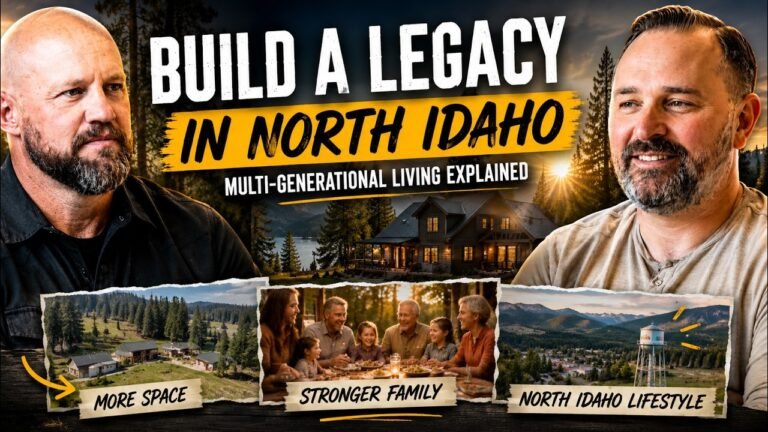
For many families moving to North Idaho, the dream is becoming bigger than simply buying a house.
They want enough land for Mom and Dad. A separate space for aging parents. Room for adult children to build later. A shop, garden, guest house, or accessory living unit. Maybe even several generations living within walking distance of one another.
Multigenerational living in North Idaho has become an increasingly common request for the North Idaho Experience real estate team, and it is easy to understand the appeal. Families can share expenses, help care for children and aging parents, preserve family relationships, and potentially create a legacy property that remains in the family for decades.
But creating that lifestyle requires more planning than simply finding 10 beautiful acres on Zillow.
What Does Multigenerational Living Look Like?
A multigenerational property can take several forms.
Some families want one large home with a separate basement apartment or in-law suite. Others prefer a detached accessory living unit, guest home, or shop with residential space. Buyers with more acreage may eventually want two completely separate homes.
In unincorporated Kootenai County, the term used in county code is an “Accessory Living Unit,” or ALU. The county defines it as a secondary, independent dwelling on the same parcel as the principal residence.
Current county code generally allows one ALU per parcel when applicable zoning requirements are met. The unit may be up to 1,000 square feet or 50% of the habitable space of the primary residence, whichever is greater.
That means a larger primary residence could potentially support a larger ALU, but zoning, septic capacity, setbacks, access, and other requirements still matter.
Septic Rules Can Change Your Entire Plan
One of the biggest considerations for anyone shopping for acreage around Coeur d’Alene, Rathdrum, Hayden, Post Falls, Athol, or nearby areas is wastewater.
Much of the region sits over the Spokane Valley-Rathdrum Prairie Aquifer, an important drinking-water resource for North Idaho and the Spokane area.
Panhandle Health District rules generally require at least five acres for a new individual subsurface sewage disposal system over the Rathdrum Prairie Aquifer, with specific exceptions for certain older parcels and approved sewage-management areas.
That can have a major impact on a family’s plans.
Buying four acres with the assumption that you can simply divide it into two two-acre homesites may not work. Even a larger property can present limitations depending on existing septic systems, proposed bedrooms, soil conditions, zoning, and the location of the parcel.
Before purchasing, review the Panhandle Health District septic permit and records resources and talk directly with Environmental Health about the property.
Kootenai County Has a Family Division Option
Families interested in creating separate parcels should also know about Kootenai County’s Family Division process.
The county currently provides an exemption allowing qualifying property owners to divide land for a gift or sale to certain immediate family members without going through the standard subdivision process. Eligible relatives can include a spouse, parent, child, sibling, grandparent, or grandchild.
There are important conditions.
Among them, ownership generally cannot have changed during the previous three years, and newly created parcels generally must contain at least five gross acres unless the underlying zoning requires something larger. Legal access and wastewater approval are also required.
For a family thinking several years ahead, this can create an interesting strategy: purchase the right acreage now, make thoughtful improvements, and explore a qualifying family division later.
Anyone considering that approach should start with the official Kootenai County Family Division Process rather than assuming a property automatically qualifies.
Why Families Want the Compound Lifestyle
The financial benefits are only part of the attraction.
Imagine grandparents living across the driveway instead of across the country.
Grandkids can walk over to Grandpa’s shop. Grandma can help with childcare. Adult children can help plow snow, maintain acreage, or assist aging parents without everyone having to live under the same roof.
Each generation can maintain some independence while still having family nearby.
For retirees, that can provide another option besides eventually moving farther away from family for additional support. For younger families, it may provide access to land or housing that would otherwise be difficult to afford independently.
There can also be efficiencies in developing the property. Depending on how a project is designed and permitted, families may be able to coordinate infrastructure such as roads, utilities, wells, shops, equipment, and other improvements.
Building a Legacy Property
The larger idea is creating something that lasts.
Instead of viewing a home solely as a place to live for the next five or ten years, a multigenerational family may be thinking about what the property looks like 30 or 50 years from now.
Parents build the primary house.
Grandparents occupy a second living space.
Later, an adult child builds on a legally divided portion of the acreage.
Eventually, the homes and land remain within the family.
That model resembles the way many families lived for generations before careers and housing patterns spread relatives across different cities and states.
For families relocating specifically because they value a closer family unit, North Idaho’s rural lifestyle and acreage options can make that vision particularly attractive.
Not Every 10 Acres Is Equal
The biggest mistake buyers can make is assuming acreage automatically equals buildability.
A 10-acre parcel may sound perfect until you discover that nine acres are steep hillside.
Before purchasing North Idaho land, investigate topography, legal access, zoning, utilities, wells, septic history, soil conditions, CCRs, easements, and subdivision possibilities.
Panhandle Health District specifically recommends that developers consult Environmental Health before beginning site work or surveying for proposed land divisions.
Kootenai County Community Development should also be an early stop when evaluating a property for a multigenerational plan.
Bring them the parcel and explain what you ultimately want to accomplish.
Plan the Lifestyle Before You Buy the Land
Multigenerational living in North Idaho can offer something many families are looking for: more connection, more independence from outside systems, shared resources, and the opportunity to create a property that outlives the original buyer.
But the best compound starts with the right land and the right plan.
Before falling in love with acreage, figure out whether the property can actually accommodate the homes, infrastructure, and future divisions your family envisions.
That extra due diligence today could be the difference between simply owning acreage and building a true North Idaho legacy property for generations to come.